👤 Rockshell Insights
20/02/2026
The industrial world is rapidly shifting toward thermal electrification to meet strict decarbonization mandates. For facility engineers, the choice between standard, off-the-shelf units and custom industrial heat pumps defines long-term profitability. While generic systems often fail in harsh environments, Rockshell Corp, a premier manufacturer from India pioneers’ application-specific designs. By tailoring thermodynamic cycles and high-grade materials like Titanium or SS316L, Rockshell provides high-temperature heat pumps capable of reaching 200⁰C. This blog explores why bespoke engineering is the only viable path to achieve the superior energy efficiency and reliability required by the global manufacturing sector.
The Thermodynamic Imperative for Customization in Industrial Heat
Customized industrial heat pumps outperform standard systems by precisely matching the heat source, sink temperature, and refrigerant properties. While standard units are typically optimized for low-lift commercial HVAC applications, industrial processes require temperatures between 90⁰C and 200⁰C. Forcing off-the-shelf equipment to operate in these ranges leads to rapid compressor wear and poor energy performance.
In contrast, Rockshell Corp engineers’ bespoke solutions using advanced compressors and tailored refrigerants to ensure a high Coefficient of Performance (COP), often reaching 4.5 to 10.0+. A key example is Rockshell’s use of Mechanical Vapor Recompression (MVR) technology. Unlike standardized units, these systems are designed to recover latent heat from waste steam, compressing it back to usable process pressures up to 14 bar. This specialized architecture creates a closed-loop thermal utility system that maximizes efficiency, providing the process stability and long-term reliability that generic equipment simply cannot deliver.
Analysing the Limitations of Standard Off the Shelf Systems
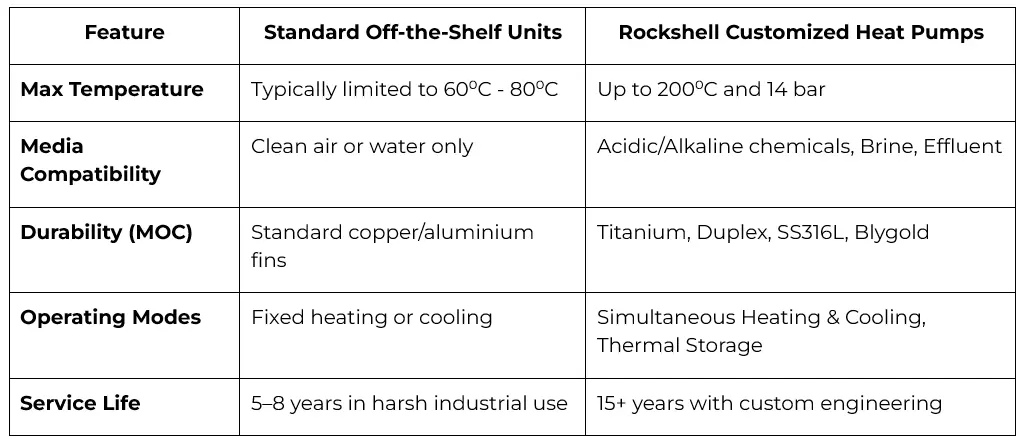
Standard heat pumps appeal to buyers due to lower upfront costs, but their design for stable commercial HVAC environments makes them unsuitable for 24/7 industrial use. Industrial settings often involve high humidity and corrosive chemicals that degrade lightweight commercial materials like thin-gauge copper-aluminium heat exchangers. Without specialized materials of construction such as the SS316L, Titanium, or Duplex steel utilized by Rockshell standard units face premature failure.
Temperature capability remains a major bottleneck; off-the-shelf units typically struggle to exceed 60⁰C to 80⁰C. This renders them incapable of meeting high-intensity industrial demands like pharmaceutical sterilization (120⁰C) or food dehydration (140⁰C). In contrast, Rockshell’s RSC-HT series is engineered to reach temperatures up to 200⁰C, bridging the technical gap that standard systems cannot cross while ensuring a service life of 15+ years.
Application-Specific Design: The Engineering Core of Rockshell
Rockshell Corp has established itself as a premier industrial heat pump manufacturer in India by focusing on the unique needs of the plant engineer. Every project begins with a site audit to understand operational patterns, measuring water flow and fuel consumption to right-size the system.
This prevents energy waste from over-sizing or performance failures from under-sizing. Customization allows for features like static fan technology for directed, uniform cooling without turbulence or “dead zones”. This precision is only possible through bespoke engineering that considers the physical layout of the factory floor.
Moreover, Rockshell provides PLC/HMI-based controllers using Siemens or Delta components with Modbus connectivity. This allows the heat pump to integrate into Building Management Systems. Smart energy management controllers then manage flows based on thermal load, renewable inputs, and time-of-use pricing, maximizing the system’s economic impact and reliability.
High-Temperature Heat Pumps for Indian Industry: Navigating Decarbonization
The Indian industrial sector faces a dual challenge – scaling production while meeting strict environmental mandates. With the Government of India’s National Mission on Energy Efficiency and the transition from the PAT scheme to the Carbon Credit Trading Scheme in 2025, thermal efficiency is now a boardroom priority. Rockshell’s high-temperature heat pumps offer a direct replacement for carbon-intensive diesel and furnace oil boilers. By electrifying process heat, manufacturers eliminate Scope 1 emissions at the point of use.
These systems can generate steam up to 200⁰C, allowing sectors like textiles and chemicals to decarbonize without compromising process stability. Economically, high-COP heat pumps provide a significant edge. With fluctuating fuel prices, the OPEX savings are substantial; for instance, a paint manufacturer using a Rockshell solution achieved a 45% reduction in annual OPEX. This bespoke approach ensures a competitive advantage that standardized, less efficient methods simply cannot deliver.
Material Science and Chemical Resilience in Customized Systems
One of the most significant advantages of application-specific heat pump design is the ability to select materials of construction that are compatible with the specific chemicals being processed. In many industrial applications, the heat pump is not just heating water but is integrated into a vacuum evaporator or a distillation column handling aggressive media. Chemical grade heat pumps must be engineered for survival in environments where standard materials would fail within months.
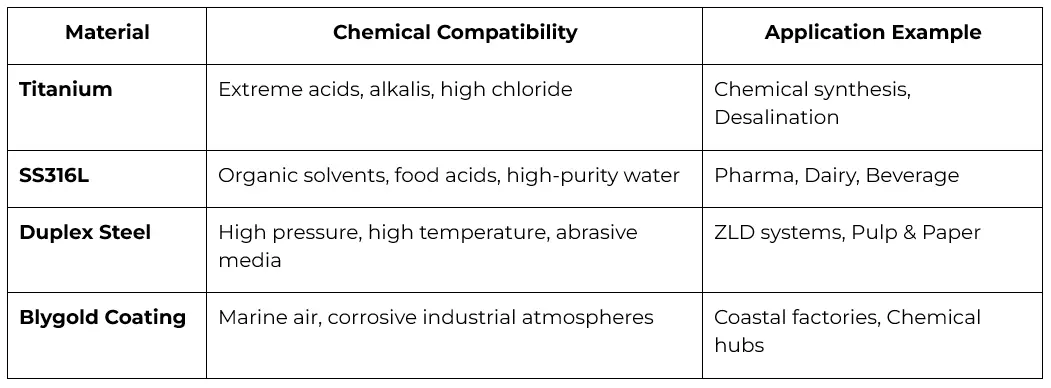
Rockshell utilizes a wide range of specialized materials to ensure equipment durability. For applications involving harsh acids or alkaline solutions, the use of Titanium heat exchangers is often the only way to prevent rapid degradation. In pharmaceutical environments where hygiene and corrosion resistance are paramount, SS316L is used for all wetted parts. For atmospheric protection, Rockshell offers Blygold coating on copper tubes and aluminium fins, which prevents corrosion from airborne chemicals or saline environments.
Beyond the heat exchangers, the entire architecture of the heat pump is built for industrial resilience. This includes high-temperature mechanical seals and sophisticated oil temperature control systems that are essential for continuous 24/7 operation in sectors like textile and chemical manufacturing. Standard units simply do not feature the heavy-duty components necessary to maintain process stability under these rigorous conditions.
Decarbonization of Thermal Processes: A Case Study Analysis
Rockshell’s bespoke engineering delivers quantifiable results, as shown by real-world applications. In the FMCG sector, a global client replaced a complex three-stage effluent treatment process with a Rockshell heat pump-based vacuum distillation unit. This single utility recovered 90% pure water and slashed COD from 200,000 ppm to 350 ppm, resulting in a 60% OPEX reduction and an 18-month ROI.
Similarly, a major paint manufacturer moved from diesel boilers to a 0.45 MW high-temperature water-to-water heat pump for emulsion processing. By integrating a buffer tank to manage peak loads, the plant saved 204,000 kg of diesel per annum and reduced CO2 emissions by 53 tonnes. This solution delivered a 45% reduction in annual OPEX, achieving full payback in just 11 months. These cases prove that customized thermal infrastructure provides superior technical performance and faster financial returns than standard systems.
Economic Framework: The Secondary Revenue of Carbon Credits
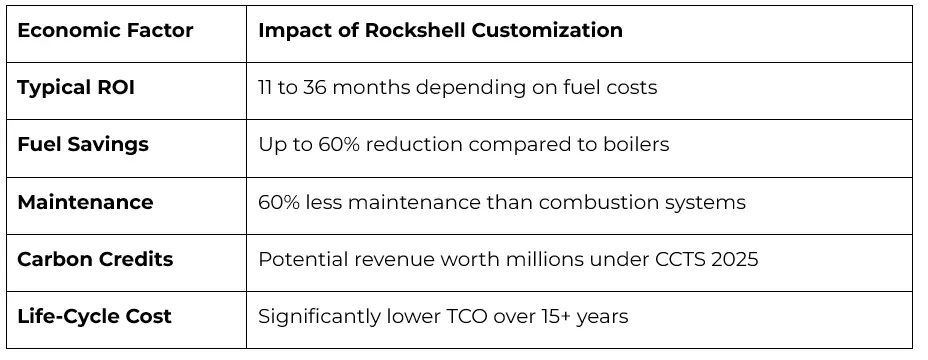
Investing in customized heat pumps is a strategic move, not just a capital expense. Under India’s 2025 Carbon Credit Trading Scheme, manufacturers exceeding emission targets earn tradable Carbon Credit Certificates, turning efficiency into a secondary revenue stream. Rockshell’s high-COP designs deliver deeper reductions than standard units, accelerating ROI. For global exporters, this technology provides a critical edge against Europe’s Carbon Border Adjustment Mechanism. By lowering carbon intensity, you avoid steep import tariffs and attract sustainable brands, future-proofing your infrastructure for the evolving global economy.
Why Rockshell? The Heritage of Indian Engineering and Global Supply
Rockshell Corp is more than just a manufacturer; it is an engineering powerhouse that brings over a century of combined expertise to every project. From a state-of-the-art facility in Navi Mumbai, Rockshell supplies high-performance machines that redefine efficiency for the global industrial sector. The company’s focus on innovation and execution has earned it a reputation as a trusted partner for over 1,000 projects across diverse industries.
The Rockshell advantage lies in the intersection of high-quality Indian engineering and competitive global pricing. Unlike international competitors who may offer standardized products with long lead times, Rockshell provides bespoke customization that is specifically tailored to the factory’s thermal profile. Whether it is a paint shop in Chennai or an FMCG plant in the United States, Rockshell’s team ensures optimal right-sizing and maximum COP for every installation.
The company’s commitment to sustainability is woven into its mission. By capturing lost energy from cooling towers, air compressors, and wastewater, Rockshell helps industries transform a liability, excess heat that requires energy to manage into an asset. This dual benefit of reducing cooling utility loads while providing heating energy is what makes the Rockshell solution particularly attractive for large-scale industrial facilities.
Technical Specifications: The Power of Customization
Rockshell’s customized heat pumps serve as advanced thermal engines, offering capacities from 10 kW to over 10 MW. These systems generate hot water up to 130⁰C and steam up to 200⁰C, while cooling ranges span from -20⁰C to +10⁰C (brine variants to -40⁰C). Efficiency is optimized through tailored low-GWP and natural refrigerants, including B. This high-intensity performance allows for simultaneous heating and cooling, providing a future-proof utility solution that integrates seamlessly into heavy industrial processes across the textile, chemical, and pharmaceutical sectors.
Conclusion: Future-Proofing Your Industrial Infrastructure
The era of inefficient, standardized heating is ending. Industries facing rising costs and decarbonization mandates must adopt customized industrial heat pumps for operational resilience. By aligning thermodynamic cycles with specific process needs, Rockshell’s bespoke designs deliver efficiencies and ROI that off-the-shelf units cannot match.
As a global leader from India, Rockshell Corp combines technical expertise with specialized material science to meet the highest global standards. With up to 60% lower maintenance costs and revenue potential from India’s 2025 Carbon Credit Trading Scheme, the economic case for customization is undeniable. Future-proof your infrastructure with Rockshell today.
Ready to Redefine Your Thermal Efficiency?
Don’t let standardized equipment limit your factory’s potential. Partner with Rockshell Corp to design a high-performance heating and cooling solution tailored to your specific industrial needs. Our team of experts is ready to conduct a comprehensive site audit and help you transition to a sustainable, energy-efficient future.
Take the first step toward decarbonization today.