👤 Rockshell Insights
10/02/2026
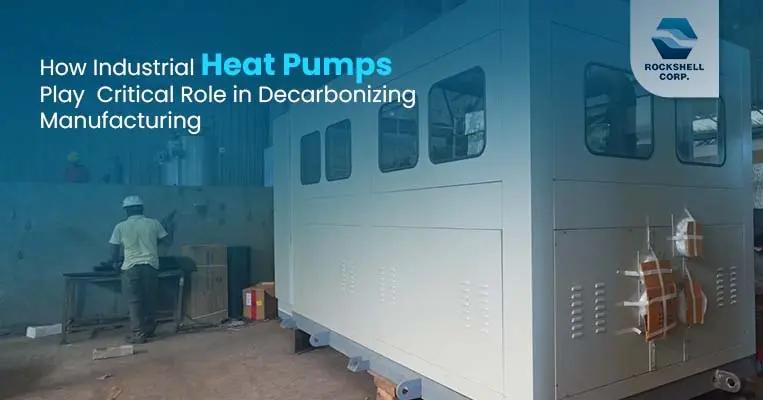
The global manufacturing sector is at a crossroads, facing soaring energy costs and urgent net-zero mandates. Decarbonizing industrial heat which accounts for 20% of global CO2 emissions is no longer optional; it is a competitive necessity. As a leading heat pump manufacturer in India, Rockshell Corp is at the forefront of this revolution, supplying heat pumps and waste heat recovery systems to industries worldwide. By replacing fossil-fuel boilers with high-temperature industrial heat pumps, manufacturers can slash carbon emissions by up to 75% and reduce operating costs by 20%.
But how exactly do these systems bridge the gap between sustainability and profitability? In this guide, we dive deep into the technical specifications of electric heat pumps for industry, exploring how Rockshell’s innovations are redefining industrial heat pumps for manufacturing decarbonization. From recovering latent heat to generating 200⁰C steam, discover the roadmap to a future-proof, electrified factory.
The Global and Indian Context for Industrial Electrification
The manufacturing sector is the largest consumer of energy globally, approx. consumes 40% of global energy, with process heating accounting for 60% of that use. The International Energy Agency projects heat pumps could meet 30% of light industry demand by 2050. In India, the ‘Panchamrit’ plan targets 500 GW of non-fossil capacity by 2030, making heat electrification strategically vital. Rockshell Corp supports this transition, helping industries replace inefficient boilers under the PAT scheme.
Economically, India’s landscape is shifting; H1 2025 saw wholesale electricity prices drop 5–15%, while fossil fuel costs remain volatile. This widening spark gap ensures rapid ROI for Rockshell installations, often within 11 months to 2.5 years. Beyond savings, adopting high-temperature industrial heat pumps enhances global competitiveness by slashing Scope 1 emissions, ensuring compliance with international sustainability standards. This shift transforms thermal management from a cost centre into a sustainable asset.
Comparative Impact: Heat Pumps vs. Traditional Boilers
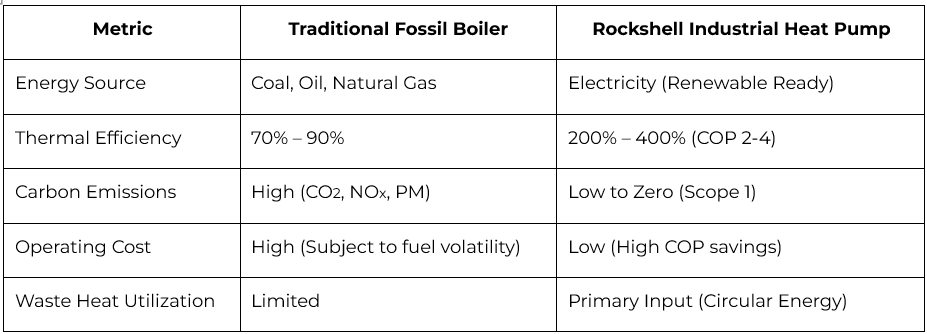
The data suggests that the transition to heat pumps is not just an incremental improvement but a total reimagining of industrial thermal management. By utilizing Rockshell’s waste heat recovery systems, a facility can transform its thermal waste into a high-value asset, achieving primary energy utilization rates that were previously thought impossible in a traditional manufacturing setting.
Core Technology: How High-Temperature Heat Pumps Work
Industrial heat pumps operate on a vapor compression cycle involving an evaporator, compressor, condenser, and expansion valve. Low-grade refrigerant absorbs waste heat, is compressed to increase temperature, and releases that energy into the process sink before recycling. This mechanism allows the system to move and pump existing thermal energy to a higher grade rather than generating it from fuel combustion.
Rockshell’s high-temperature units utilize specialized screw and Roots compressors to handle intense thermal stresses and achieve stable lifts beyond 100⁰C. For demanding distillation or sterilization, Rockshell’s steam heat pumps employ centrifugal technology to generate process steam up to 14 bars (200⁰C). Compliance is ensured through next-generation hydrofluoroolefins (HFOs) and natural refrigerants like R1233zde and R1234ze, which offer low Global Warming Potential (GWP) and 15–20-year lifespans.
Technical Specifications: Rockshell High-Temperature Series
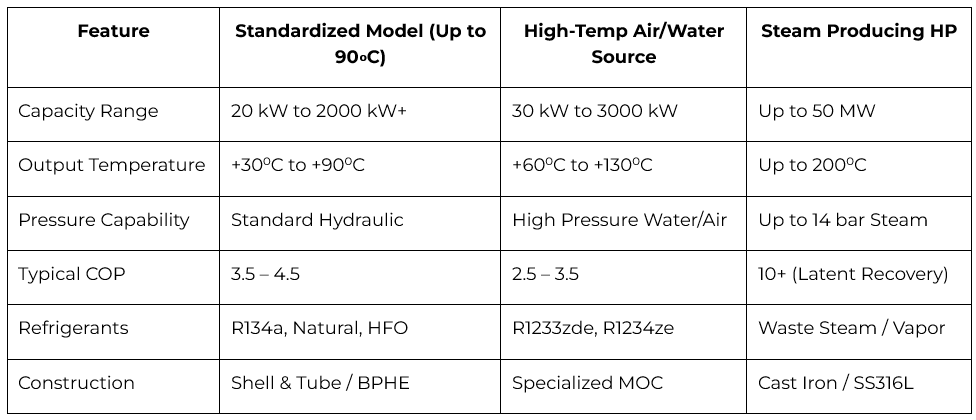
The versatility of this product lineup ensures that Rockshell can address a wide spectrum of industrial needs, from medium-temperature water heating for commercial laundries to high-pressure steam for pharmaceutical autoclaves. The engineering team at Rockshell provides full system delivery, including pumps, buffer vessels, and advanced controllers with $BMS$ integration, ensuring a seamless transition from legacy boiler systems.
Waste Heat Recovery Systems: The Hidden Efficiency Lever
Manufacturing facilities frequently discard low-grade thermal energy (25⁰C to 40⁰C) through cooling towers and effluent discharge. Rockshell’s waste heat recovery systems capture this latent energy and lift it to temperatures as high as 130⁰C, making it usable for essential factory processes. This circular approach achieves COPs exceeding 4.0 delivering 4 units of heat for every 1 unit of electricity, driving the 45% annual OpEx savings observed in Rockshell installations.
These modular, skid-mounted units support simultaneous heating and cooling, providing chilled water for production while preheating boiler feedwater or facility spaces. By repurposing flue gas, exhaust air, and cooling tower blowdown, manufacturers significantly reduce fuel dependency and meet Scope 1 emission targets. This integration increases operational resilience against energy disruptions while transforming thermal waste into a high-value industrial asset.
Potential Heat Sources for Recovery in Manufacturing
- Cooling Tower Circuits: Extracts heat from water loops before it is dissipated into the atmosphere.
- Air Compressor Cooling: Utilizes the high-grade heat generated by industrial air compression systems.
- Wastewater/Effluent: Recovers energy from hot discharge liquids in the textile, food, and chemical sectors.
- Refrigeration Condensers: Taps into the heat rejected by existing ammonia or chiller systems.
- Flue Gas Stacks: Captures heat from exhaust flues using specialized gas-to-liquid exchangers.
High-Temperature Industrial Heat Pumps: Breaking the 100⁰C Barrier
High-temperature industrial heat pumps have bridged the gap to intensive processes like sterilization and distillation. Rockshell’s steam-producing models generate process steam up to 14 bars (200⁰C), directly competing with fossil-fuel boilers. These systems are particularly effective when recovering latent heat from waste vapor, where phase-change mechanics allow for extremely high COPs exceeding 10+.
Deploying high-temperature units allows for de-steaming replacing inefficient centralized steam networks with localized, point-of-use heating. This reduces transportation losses and enhances process control. Rockshell’s operating range includes hot water up to 130⁰C and hot air up to 130⁰C for drying and dehydration, providing a comprehensive toolkit for total facility electrification.
Operating Ranges: Rockshell High-Temperature Solutions
- Hot Water Generation: Capable of delivering precise temperatures up to 130⁰C for process heating and washdown.
- Steam Generation: Producing process-grade steam up to 200⁰C for intensive industrial cycles.
- Hot Air Delivery: Specialized air-to-air units delivering up to 130⁰C hot air for industrial drying and dehydration.
- District Heating: Upgrading ambient or waste heat to 120⁰C for large-scale heat distribution.
Dual and Multi-Source Units: Intelligent Thermal Management
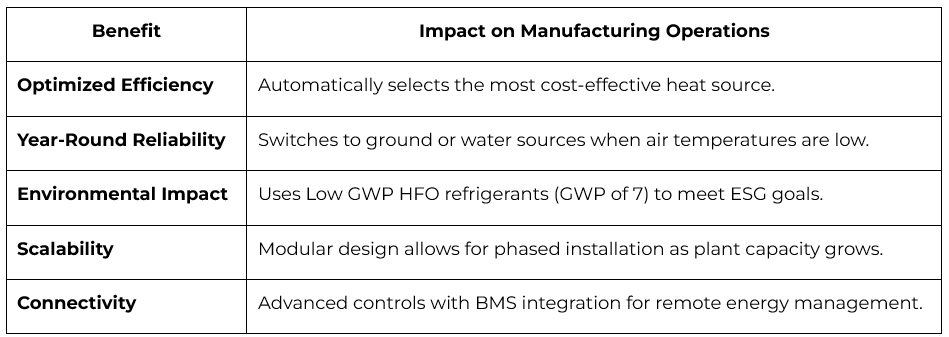
Industrial environments are characterized by fluctuating thermal loads and varying ambient conditions. To address this, dual and multi-source heat pumps provide unmatched flexibility by switching between air, water, and ground sources based on real-time efficiency. During milder months, the system may extract heat from ambient air; as temperatures drop, intelligent source switching automatically engages water or ground loops to maintain peak COP. This ensures reliable 24/7 operation regardless of seasonal shifts.
These units are designed for complex thermal profiles, featuring multiple evaporators to tap into diverse energy streams simultaneously. Rockshell’s systems also offer a capacity turn-down of 10% to 20%, matching output to fluctuating production demands. This precision prevents energy wastage and stabilizes temperature profiles for sensitive pharmaceutical and food processing environments.
Benefits of Rockshell Multi-Source Configurations
Deep Sectoral Analysis: Where Heat Pumps Make the Most Impact
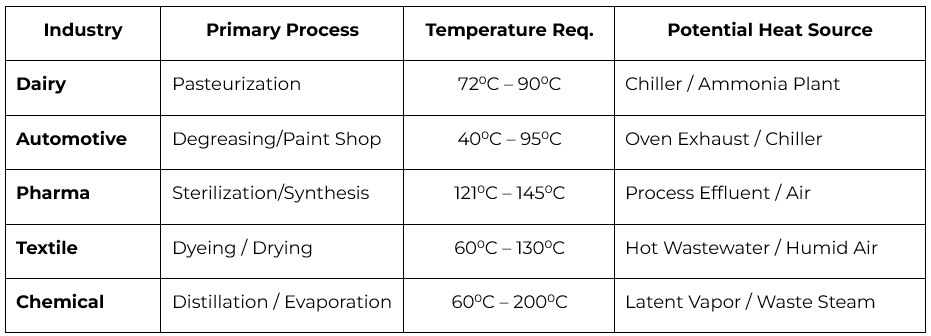
The role of industrial heat pumps for manufacturing decarbonization varies significantly across different industrial sectors. Each industry has its own thermal signature, a unique set of temperature requirements and waste heat availability. Rockshell Corp’s engineering team specializes in tailoring solutions to these specific sectoral needs, ensuring that the technology is integrated for maximum effectiveness.
Food and Beverage Industry
The food and beverage sector is a prime candidate for heat pump adoption, as a large portion of its thermal demand (pasteurization, sterilization, and cleaning) occurs below 100⁰C. Processes like milk pasteurization require temperatures around 72⁰C to 90⁰C, while Clean-in-Place (CIP) systems need reliable hot water for sanitization. Rockshell’s standardized models and high-temperature water-source units provide the steady, 24/7 supply of hot water needed for these operations, often utilizing waste heat from refrigeration chillers to achieve extremely high efficiencies.
Pharmaceutical and Chemical Production
In the pharmaceutical sector, temperature control is a matter of compliance and safety. Processes like chemical synthesis, distillation, and solvent recovery require precise, stable thermal energy. Rockshell’s high-temperature steam heat pumps provide the high-grade heat necessary for SIP cycles and autoclaving. By replacing carbon-heavy steam boilers with electrified heat pumps, pharmaceutical plants can achieve their net-zero targets while maintaining the cGMP precision required for life-saving medicines.
Automotive and Motor Industry
The automotive industry, particularly paint shops, is one of the most energy-intensive manufacturing environments. Degreasing and chemical treatment baths must be maintained between 40⁰C and 90⁰C for optimal results. Rockshell has successfully delivered heat pump systems to major automotive manufacturers, recovering waste heat from curing ovens and cooling processes to heat pretreatment baths. These installations have demonstrated energy cost reductions of up to 65% to 70%, with CO2 savings of hundreds of tons per year.
Textile and Paper Manufacturing
Drying and finishing processes in the textile and paper industries require large volumes of hot air and low-pressure steam. Rockshell’s air-to-air heat pumps are designed to deliver hot air up to 130⁰C for applications like fabric drying and food dehydration. These units not only provide the necessary heat but also dehumidify the air, improving the overall efficiency of the drying cycle. In paper production, heat pumps can recover latent heat from the humid exhaust of paper machines, returning usable thermal energy back into the production loop.
Sectoral Temperature and Source Matrix
Economic Viability and ROI: The Business Case for Heat Pumps
The decision to adopt heat pumps for industry is driven by rapid payback periods, often between 11 months and 2.5 years. By switching from diesel or gas boilers to a Rockshell unit with a COP of 3.0+, facilities cut heating energy consumption by 60% to 75%. Maintenance is also lower; as closed-loop systems without combustion, heat pumps require far less cleaning and servicing than traditional boilers.
In India, the PAT scheme and ESCerts provide additional financial incentives for meeting energy-saving targets. Furthermore, pairing heat pumps with on-site solar reduces the marginal cost of heating to nearly zero.
Why Rockshell? India’s Global Heat Pump Specialist
Rockshell Corp combines 100+ years of combined experience with world-class manufacturing standards. As a premier heat pump manufacturer in India, they specialize in customized units tailored to specific industrial chemistries and hydraulic profiles. Rockshell uses SS316L and Titanium construction for durability and next-generation HFO refrigerants for future-proof sustainability.
Clients benefit from full lifecycle support, from initial energy audits and modular skid mounting to remote global monitor diagnostics. This commitment to build quality and connectivity is why global brands trust Rockshell for critical thermal management.
Conclusion: Driving the Future of Sustainable Manufacturing
Industrial heat pumps are the critical engine for manufacturing decarbonization. By displacing fossil-fuel boilers with efficient, electric systems, industry owners can achieve 75% carbon reductions and 45% OpEx savings. Rockshell Corp stands as a leader in this transition, providing the MW-scale and high-temperature technology needed to electrify global production. The path to Net Zero 2070 starts with smarter thermal management today.
Ready to slash your carbon footprint and energy bills? Partner with Rockshell Corp, the leading heat pump manufacturer in India. Explore our heat pump solutions or contact our experts for a custom energy audit today.