👤 Rockshell Insights
20/01/2026
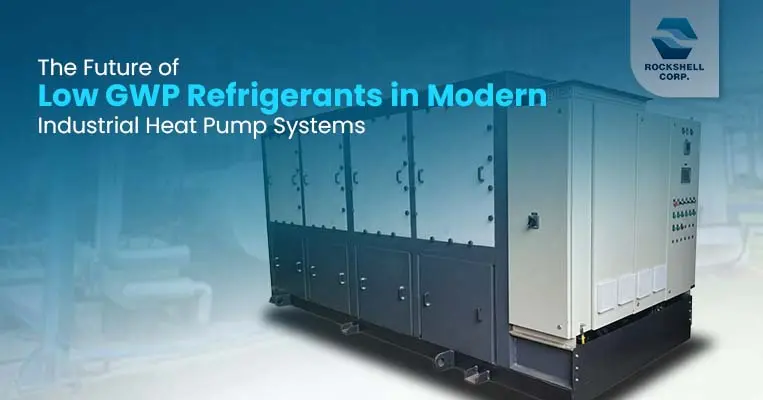
The global industrial sector stands at a critical juncture as 2026 approaches, facing an urgent mandate to reconcile high-capacity thermal requirements with stringent environmental regulations. The transition toward the decarbonization of industrial heating is no longer a peripheral sustainability goal but a core operational requirement for manufacturing resilience and market compliance. Central to this transformation is the adoption of Low GWP refrigerants, which are redefining the efficiency and environmental footprint of industrial heat pump systems. As a leading manufacturer from India with a global supply footprint, Rockshell Corp has pioneered the integration of these sustainable refrigerants into high-temperature systems, enabling industries to transition from fossil-fuel dependency to high-efficiency electrification.
The year 2026 is widely recognized as a pivotal milestone for the adoption of natural refrigerants, marking a major trend where industrial facility owners and engineers are prioritizing future-proof technology over legacy systems. This shift is driven by the tightening of global frameworks such as the EU F-Gas Regulation (EU 2024/573), which accelerates the phase-down of hydrofluoro carbons (HFCs) that possess high global warming potential. For industrial leaders, selecting a heat pump system is now a decision that encompasses thermodynamic performance, regulatory longevity, and the total cost of ownership. Rockshell’s engineering philosophy addresses these multifaceted challenges by utilizing next-generation refrigerants that offer ultra-low GWP values while maintaining or exceeding the performance standards of traditional fluids.
The Strategic Framework for Industrial Decarbonization
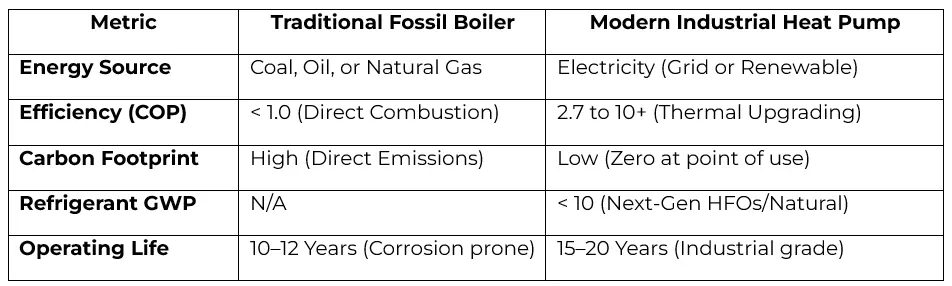
Decarbonizing industrial heat is a complex endeavour, as approximately 50% of global energy consumption is dedicated to heating and cooling, with a significant portion utilized in industrial processes. Traditionally, this heat was generated through the combustion of fossil fuels in boilers, a process characterized by low efficiency and high carbon intensity. The integration of modern industrial heat pump systems provides a thermodynamic pathway to recover waste heat and upgrade it to useful temperatures, often reaching up to 200⁰C or even 300⁰C in specialized Rockshell variants. By utilizing electricity to move heat rather than generate it through combustion, these systems achieve efficiencies that are physically impossible for boilers to match.
The fundamental shift occurring in 2026 involves the move away from high-GWP HFCs like R-410A and R-407C, which have GWP values in the thousands. The new industrial standard focuses on refrigerants with GWP values typically under 10, such as R-1233zde, R-1234ze, and natural refrigerants like Ammonia (R-717) and water (R-718). This transition is supported by data indicating that natural refrigerant applications will capture nearly 22.7% of the total technology share in the heat pump market by 2026. Rockshell Corp has strategically aligned its product development with these trends, ensuring that its global clientele can meet climate goals without compromising on the rigorous thermal demands of chemical, pharmaceutical, or food processing sectors.
Thermodynamic Principles and Sustainable Refrigerants
The operation of an industrial heat pump system is governed by the second law of thermodynamics, utilizing a closed-loop vapor compression cycle to move energy from a low-temperature source to a high-temperature sink. This process relies on the specialized properties of the refrigerant, which acts as the thermal transport medium. In a typical Rockshell system, the cycle begins in the evaporator, where the low-GWP refrigerant absorbs waste heat from sources such as cooling tower returns, air compressor jackets, or industrial effluent. This heat absorption causes the refrigerant to transition from a liquid to a gas at low pressure.
The efficiency of this transition is significantly influenced by the molecular structure of sustainable refrigerants. Hydrofluoroolefins (HFOs) like R-1233zde and R-1234ze have been engineered with a double carbon bond that ensures rapid atmospheric breakdown, resulting in a GWP of less than 1. Despite this environmental fragility in the atmosphere, these fluids exhibit exceptional thermodynamic stability within the high-pressure environments of industrial compressors. Rockshell utilizes R-1233zde for applications delivering temperatures up to 125C to 130C, while R-1234ze is optimized for requirements up to 90⁰C, providing a tailored solution for various process needs.
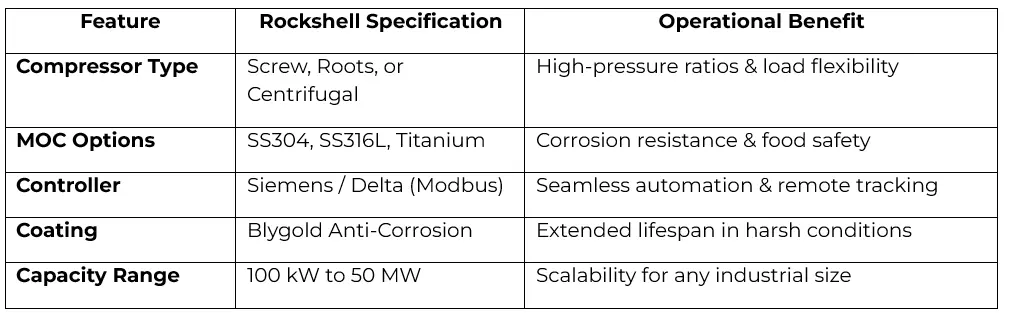
The work input required for this process is provided by the compressor, which Rockshell engineers for high-pressure ratios and operational flexibility. By compressing the low-pressure gas, the system elevates its temperature and energy density. The heat is then released in the condenser to the process fluid, such as water or air, while the refrigerant condenses back into a liquid, ready to repeat the cycle. The Coefficient of Performance (COP) of this cycle is the primary indicator of efficiency, calculated as the ratio of useful heat output to the work input.
For industrial facility owners, the COP represents a direct multiplier of energy productivity. Rockshell’s RSC-HT series achieves a combined COP of 4.5 by simultaneously providing heating and cooling, while its specialized steam-producing heat pumps can reach a COP of 10 or higher when optimized for upgrading waste vapor through Mechanical Vapor Recompression (MVR) technology.
Natural Refrigerants: The Major Industry Trend for 2026
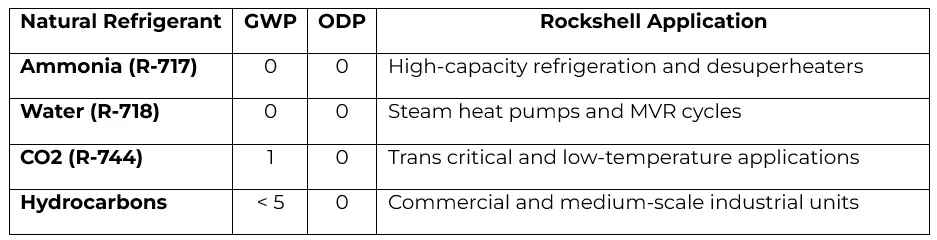
As the market approaches 2026, the adoption of natural refrigerants has emerged as a dominant strategy for long-term regulatory compliance. Unlike synthetic fluids, natural refrigerants are substances that occur in the Earth’s bio-cycles, meaning they have zero or negligible impact on ozone depletion and global warming. Ammonia (R-717) and water (R-718) are the cornerstones of this movement in the industrial heating sector. Rockshell Corp integrates these natural fluids into large-scale systems to provide a solution that is entirely immune to the evolving phase-down schedules of the F-Gas regulations.
Ammonia is particularly valued for its excellent heat transfer properties and high latent heat of vaporization, making it ideal for large-capacity industrial heat pumps and chiller desuperheaters. In MVR cycles, water itself serves as the refrigerant, a breakthrough that eliminates chemical handling concerns entirely. By using waste steam as the primary input and compressing it to higher pressures, Rockshell’s steam heat pumps generate high-grade industrial steam without any synthetic refrigerants. This approach aligns perfectly with the sustainability mandates of the 21st-century factory, where water-based systems are preferred for their non-toxic, non-flammable, and zero-GWP characteristics.
Engineering Rockshell Systems for High-Temperature Output
The ability to deliver heat at temperatures exceeding 100⁰C is the defining characteristic of a high-temperature heat pump. Many standard heat pumps struggle to maintain efficiency or mechanical integrity as output temperatures rise, but Rockshell’s RSC-HT series and steam heat pumps are specifically designed for these demanding lifts. Through the use of advanced semi-hermetic screw compressors, centrifugal compressors, and Roots-type compression technology, Rockshell systems can generate pressurized hot water up to 132⁰C and steam up to 14 bar and 200⁰C.
Material selection is a critical component of this engineering excellence. Industrial processes often involve corrosive or sensitive fluids, necessitating high-grade Materials of Construction. Rockshell offers heat exchangers in SS304, SS316L, and even Titanium to ensure longevity and prevent cross-contamination. For condenser units, all wetted parts can be constructed from SS316L, providing a robust solution for heating DM water in chemical emulsion processes or treating effluent in Zero Liquid Discharge (ZLD) systems.
The modular and skid-mounted design of these machines allows for rapid deployment and integration. This plug-and-play architecture is essential for modern factories that cannot afford extended downtime during the transition to greener heating technology. By being “retrofit-ready,” Rockshell units can be integrated directly into existing boiler or steam networks, serving as the primary heat source while the traditional boiler is relegated to a backup or peaking role. This phased approach reduces transition risks and allows facility owners to witness the operational savings before full-scale electrification.
Waste Heat Recovery: Capturing the Unused Resource
One of the most profound insights for industrial engineers in 2026 is the realization that a factory’s waste heat is a high-value asset, not a disposal problem. Industrial plants produce vast quantities of low-temperature heat that is traditionally vented into the atmosphere through cooling towers or exhaust stacks. An industrial heat pump system acts as a thermal harvester, capturing this energy and upgrading it to a level where it can replace expensive fuel consumption.
Common waste heat sources utilized by Rockshell systems include:
- Cooling Tower Waste: Water at 30⁰C to 40⁰C that would otherwise require fan energy to cool down.
- Air Compressor Cooling: Capturing the heat generated during the compression of industrial air.
- DG Set Cooling Jackets: Utilizing the thermal energy from diesel generator operations.
- Ammonia/Chiller Desuperheaters: Recovering high-grade heat from refrigeration cycles.
- Chilled Water Return: Extracting heat from 12⁰C return lines to provide simultaneous cooling and heating.
By integrating these sources, the heat pump reduces the load on both the heating system and the cooling utilities. For example, by extracting heat from a cooling tower circuit, the heat pump provides a “free” cooling effect, reducing the electricity consumed by cooling tower fans. This dual-utility performance is a hallmark of the Rockshell engineering philosophy, maximizing the exergy of every kilowatt-hour consumed.
Industry-Specific Applications and Case Studies
The versatility of Low GWP refrigerant heat pumps allows them to be applied across a broad spectrum of manufacturing sectors. Each industry has unique thermal profiles, yet the common denominator remains the need for cost-effective, sustainable heat. Rockshell’s systems are tailored to these specific needs, as evidenced by their extensive project history across global markets.
Chemical and Pharmaceutical Processing
In the chemical and pharmaceutical industries, temperature precision and corrosion resistance are non-negotiable. Rockshell heat pumps are used to heat alkaline or acidic chemicals, facilitate distillation, and power evaporation units. For a major paint manufacturer in Asia, Rockshell delivered a 468-kW water-to-water heat pump to heat DM water for an emulsion process. By replacing diesel boilers, the client achieved a 45% reduction in annual Opex and a return on investment (ROI) in just 11 months.
Food and Beverage Manufacturing
The food sector requires significant thermal energy for pasteurization, sterilization, and drying. A high-temperature heat pump can capture heat from refrigeration condensers and upgrade it to the 70⁰C to 90C range required for these processes. For drying applications, Rockshell’s air-to-air systems deliver hot air up to 130⁰C for food dehydration, spray drying, and sludge processing, utilizing high-quality SS304 or SS316 coils to ensure food-grade safety.
Textile and FMCG Sectors
Textile dyeing and washing are energy-intensive processes that generate large volumes of warm wastewater. Rockshell systems capture this energy to preheat process water, significantly reducing the coal or gas required by traditional boilers. In the FMCG sector, Rockshell implemented a 1MW heat pump-based vacuum distillation unit for effluent treatment. This system reduced the effluent’s COD from 200,000 ppm to 350 ppm while recovering 90% of the water for reuse, delivering an ROI of 18 months.
The Economic Logic: ROI, Opex, and Carbon Credits
While the environmental benefits of transitioning to sustainable refrigerants are clear, the economic case is the primary driver for industry owners. The total cost of ownership of a Rockshell heat pump is significantly lower than that of a combustion boiler due to the dramatic reduction in operational expenses. With fuel prices for diesel, natural gas, and furnace oil remaining volatile, the stability and efficiency of electric heat pumps offer a compelling financial advantage.
The ROI for a typical industrial installation range from 11 to 24 months, depending on the heat source and fuel being replaced. Beyond direct energy savings, companies can benefit from Carbon Credit Trading Schemes and international mechanisms like the Carbon Border Adjustment Mechanism. By documenting the massive CO2 reductions achieved through heat pump adoption, often hundreds of tonnes per annum—facility owners can generate additional revenue streams or avoid heavy carbon taxes.
Maintenance costs further tilt the scales in Favor of heat pumps. A combustion system involves burners, chimneys, fuel storage, and complex fire-safety requirements. In contrast, a Rockshell heat pump system is an electrical machine with approximately 60% lower maintenance requirements. With no open flames and no fuel handling, the operational risk profile is substantially improved, allowing for a safer and cleaner factory environment.
Operational Resilience and Advanced Controls
In an industrial setting, equipment reliability is paramount. A failure in the heating system can halt an entire production line, leading to massive financial losses. Rockshell addresses this through redundant design features and high-quality components. The use of semi-hermetic screw compressors allows for precise capacity control, ensuring that the heat pump can match the thermal load of the process exactly, rather than cycling on and off like less sophisticated units.
The integration of smart technology is a major trend for 2026, where IoT-enabled infrastructure allows for real-time monitoring and diagnostics. Rockshell systems are equipped with Siemens or Delta controllers that offer Modbus connectivity. This allows for seamless integration into the factory’s existing Building Management System (BMS) or SCADA network, enabling engineers to track COP, monitor temperature lifts, and perform predictive maintenance from a central control room.
To protect against harsh industrial environments, Rockshell offers specialized coatings like Blygold for copper tubes and aluminium fins, which prevents corrosion and maintains heat transfer efficiency over the system’s 15-to-20-year lifespan. This level of customization ensures that whether the machine is installed in a high-humidity textile mill or a chemically active pharmaceutical plant, it will continue to deliver peak performance.
Why Rockshell: A Legacy of Innovation from India to the World
Choosing a manufacturer is as much about the engineering as it is about the partnership. Rockshell Corp is an industrial pioneer based in India, specializing in customized heating and cooling solutions for a global market. With over 100 years of combined team experience and more than 1,000 successfully completed projects, Rockshell brings a depth of technical knowledge that is rare in the rapidly evolving heat pump sector.
The company’s manufacturing facility in Navi Mumbai serves as a hub for innovation, where advanced thermodynamic cycles are designed and tested for global deployment. By choosing Rockshell, industrial owners are not just buying a machine; they are accessing a complete engineering ecosystem. From initial feasibility studies and site audits to the selection of the optimal Low GWP refrigerant and final commissioning, Rockshell manages the entire value chain to ensure project success.
Rockshell’s ability to deliver temperatures up to 200⁰C and pressures up to 14 bar positions it at the very top of the industrial heat pump market. This capability allows for the replacement of traditional steam boilers in high-intensity applications that were previously thought to be impossible to electrify. By combining the benefits of sustainable refrigerants with world-class engineering, Rockshell is enabling a circular energy economy within the world’s most demanding factories.
Conclusion: Securing the Future of Industrial Heat
The future of industrial heating is undeniably electric, and the catalyst for this change is the deployment of Low GWP refrigerant heat pump systems. As we enter 2026, the convergence of regulatory deadlines and the proven economic benefits of high-efficiency thermal upgrading have made the transition to sustainable heat pumps a strategic necessity. By capturing waste heat and upgrading it through advanced compression technology, industries can achieve unprecedented levels of energy productivity while simultaneously meeting their climate commitments.
Rockshell Corp stands as the definitive partner for this transition, providing the expertise and the hardware required to transform industrial utilities from a cost centre into a sustainable asset. Whether the goal is to generate high-pressure steam, treat effluent through ZLD, or simply reduce the carbon footprint of process heating, Rockshell’s Low GWP solutions provide the reliability and efficiency required for the 21st-century manufacturing landscape. The choice is clear: future-proof your operations with technology that respects the environment without compromising on industrial performance.
Experience the Rockshell Advantage
Ready to lead the transition to sustainable industrial heating? Transform your factory’s energy profile with Rockshell’s high-temperature heat pump solutions. Our team of specialists is ready to conduct a site audit and help you identify the massive Opex and CO2 savings available within your facility.
Contact Rockshell Corp Today:
- Official Website: www.rockshellcorp.com
- Email Support: support@rockshellcorp.com
- Direct Inquiry: +91 8097588428 / +91 9702812944
- Factory Location: MIDC, Rabale, Navi Mumbai, India.
From Waste Heat to Useful Heat – Your Partner in Global Industrial Decarbonization.